Jul 1, 2026
Blog
BIAN Explained
The Global Standard Behind Modern Banking Architecture
Banking technology grew fast, but didn't grow together
For decades, banks expanded by adding systems: a new core system here, payment platform there, a CRM on top, and a compliance layer on the side. Each addition solved a problem but also created a new one: how do you get all these systems to actually talk to each other?
The answer, almost universally, was custom integration. Teams of engineers building bespoke connectors between systems that were never designed to work together. Every integration triggered another round of expensive, time-consuming engineering.
According to a McKinsey research report, banks were spending as much as 70% of their IT budgets just maintaining what they had, leaving almost nothing for what they actually wanted to build. Innovation became a luxury that only the largest institutions could afford, and even then, it moved far too slowly.
Branch staff felt this most acutely. A teller opening an account, processing a loan, or resolving a customer issue often had to navigate four or five disconnected systems — each with its own interface and its own logic.
BIAN was born to define a common language that would let systems, vendors, and institutions work together without starting from zero every single time.
Enter BIAN: a blueprint for the entire industry
In 2008, a group of forward-thinking banks, software vendors, and service providers came together to found the Banking Industry Architecture Network, BIAN. The idea was straightforward but ambitious: if 80% of banking architecture is essentially the same across all institutions, why not define that shared foundation once, and build on top of it?
Founding members included Microsoft, SAP, Temenos, Deutsche Bank, Credit Suisse, ING, and SWIFT — a coalition that signaled serious intent from day one.
Since its first framework release in 2012, BIAN has grown into a global standard. Today it covers 326 service domains across 38 banking business functions, and counts more than 120 member organizations worldwide.
Modular by design — the LEGO brick philosophy
In simple words, BIAN decomposes the bank into discrete, reusable "service domains" — each one representing a specific business capability like payments, customer onboarding, risk management, or branch operations. Each domain connects to others through standardized APIs, creating an architecture that is flexible, scalable, and easy to maintain.
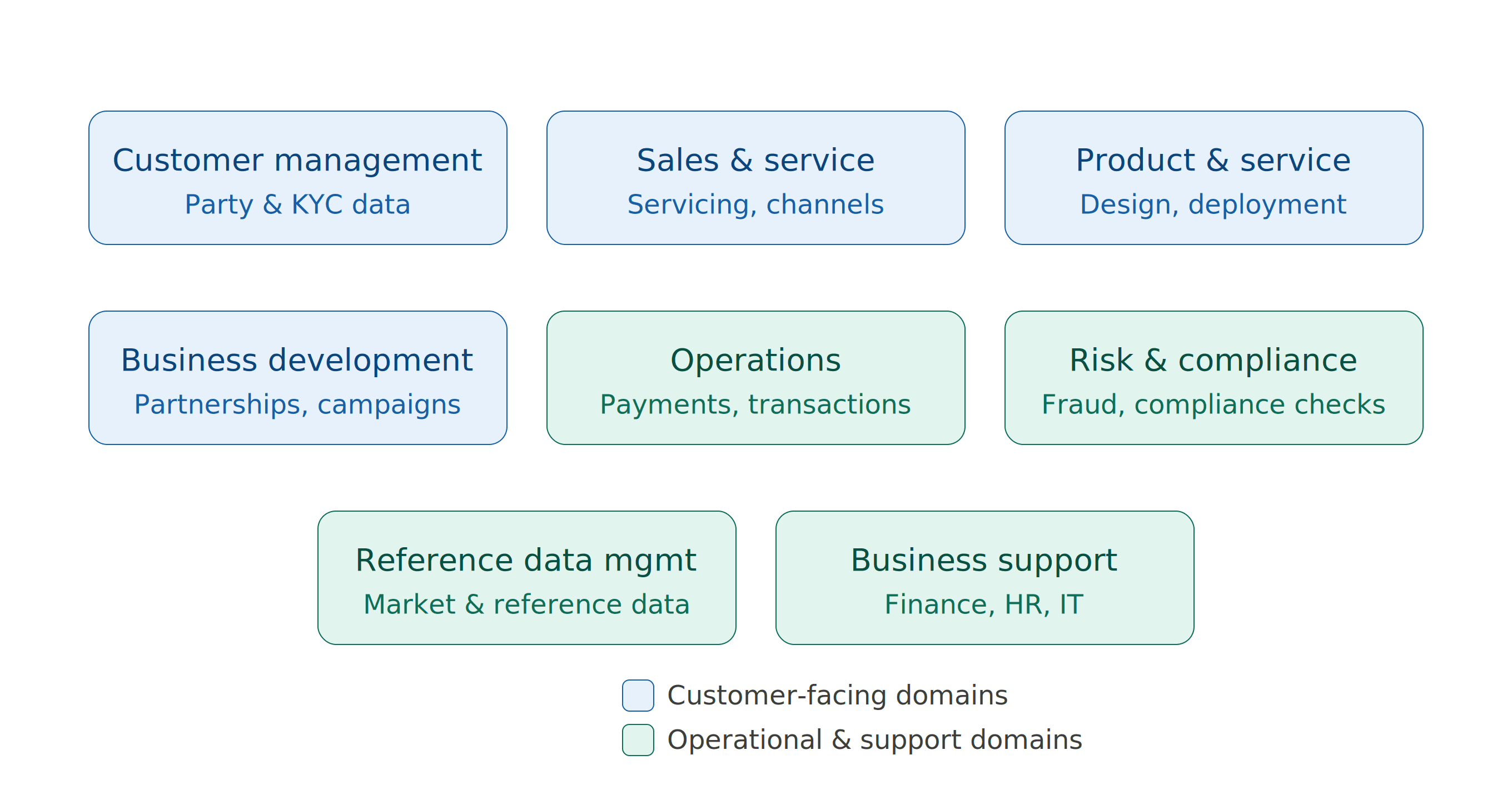
This diagram groups BIAN's ~300+ service domains into their eight core business areas, split visually into customer-facing functions and operational/support functions .
Think of it as LEGO bricks: each piece is independently designed and tested, but they all share the same connection system. Banks can assemble, replace, or upgrade individual components without rebuilding everything from scratch.
For branch software specifically, this means that the systems tellers and platform bankers use every day can finally integrate seamlessly with back-office platforms, digital channels, and third-party services — with no costly custom engineering required.
Real institutions, real results
BIAN adoption has moved well beyond early experiments. Financial institutions across four continents are already building on the framework:
North America
PNC Bank used BIAN to map its entire application landscape and develop internal APIs, reducing time-to-market for new capabilities and cutting vendor lock-in.
Santander defined a common API framework across its 13 group entities, using BIAN to identify synergies and standardize development across the organization.
HSBC formed five internal working groups to incorporate BIAN as an industry reference framework, redesigning ways of working around a common business capability model.
JPMorgan Chase is investigating BIAN adoption at multiple levels — including semantic APIs and capability modeling — to build a common abstraction layer across its systems.
Africa
Absa Bank consolidated 20 separate payment services down to just 4 — dramatically reducing maintenance costs while enabling a composable, plug-and-play service architecture.
Standard Bank Group, winner of BIAN’s Adoption Leader award, has been building on the framework since 2019, with each round of initiatives delivering compounding returns.
Australia & Asia-Pacific
Commonwealth Bank of Australia was recognized as BIAN Transformation Champion and hosted a major BIAN event sharing its implementation experience and lessons learned.
ANZ Bank and National Australia Bank (NAB) both joined BIAN in 2024 as part of a wave of 27 new member organizations.
Latin America
Banco Pichincha — one of the largest banks in Ecuador with a strong presence across Latin America — joined BIAN in 2024, signaling that the standard’s reach is now genuinely global.
Brazil’s financial sector, known for its sophisticated digital banking ecosystem, is a natural next frontier for BIAN adoption as its institutions pursue deeper core modernization.
The door is open
At the center of it all sits one fundamental challenge: can your systems actually keep up? Can your branch talk to your core? Can your core talk to your partners? Can you onboard a new fintech in weeks instead of months? Can you launch a new product without a six-figure integration project?
BIAN makes all of this possible by design. It provides the shared language, the modular structure, and the API standards that turn a fragmented technology landscape into a connected, agile ecosystem.
The institutions that have embraced BIAN are already moving faster, integrating cheaper, and innovating more freely. The gap between them and those still running on siloed architectures is widening every single quarter.
That is where branch software changes the game. When your branch platform is modular, API-based, and designed around BIAN's service domain philosophy, the branch stops being the most disconnected part of the bank and becomes one of the most connected. Tellers work in one unified environment. Customer data flows without friction and new capabilities can be switched on without rebuilding the whole stack.
Where we stand
A note from Gearoid
I have always been a standards nerd. I love specifications, models, and clean patterns. Back in the day, I even became a UML-certified professional (if anyone else remembers that badge of honor!). For me, visualizing a solution through a diagrammatic language and OCL just made sense. Naturally, when I encountered the BIAN framework, it clicked instantly.
In the early days of Antuar, while designing our data structures, our walls were covered in printouts of BIAN Service Domains and Business Object Models. Years later, mapping to various APIs, it always makes me smile to see how closely — and sometimes loosely — organizations align with them. It’s proof that those core models we started with are still incredibly relevant.
So, how close are we? closer than you might expect. BIAN certification is a structured journey that recognizes software vendors who have genuinely built their products around open banking standards. For a company like ours, pursuing certification is less about changing what we do and more about formalizing and demonstrating what we already believe in.
#BIAN #BankingTechnology #DigitalTransformation #SoftwareArchitecture #OpenBanking #ModularDesign #Antuar #BranchInnovation
Sources
Framework & Research
[1] McKinsey & Company. “AI for IT Modernization: Faster, Cheaper, Better.” December 2, 2024. https://www.mckinsey.com/capabilities/quantumblack/our-insights/ai-for-it-modernization-faster-cheaper-and-better
[2] BIAN e.V. Official website and service landscape portal. https://bian.org
[3] BIAN Services. Case Studies — PNC, Santander, HSBC, Citi. https://bian-services.com/case-studies/
[4] BIAN e.V. “BIAN Implementation Examples v1.” 2020. https://bian.org/wp-content/uploads/2024/11/BIAN_Implementation_Examples_v1.pdf
Bank Adoption
[5] Commonwealth Bank of Australia — BIAN Transformation Champion. Referenced via BIAN official communications and event coverage. https://bian.org
[6] BIAN. “27 New Members Join BIAN in 2024 — Including ANZ, NAB, and Banco Pichincha.” BIAN Member Announcements, 2024. https://bian.org/about-us/members/
[7] Global Banking & Finance Review. “BIAN Model Put into Practice at PNC Bank.” https://www.globalbankingandfinance.com/bian-model-put-into-practice-at-pnc-bank
[8] ITWeb / BBD Software. “Rethinking the Core: Why BIAN is Banking’s Quiet Revolution.” October 2025. https://bbdsoftware.com/article/how-bian-is-reshaping-core-banking/
Industry Context
[9] BIAN e.V. “BIAN v12.0 Release Notes.” December 2024. https://bian.org/wp-content/uploads/2024/12/BIAN-v12.0-Release-Notes-v0.4.pdf
[10] Grokipedia. “Banking Industry Architecture Network — Membership and Framework Overview.” https://grokipedia.com/page/Banking_Industry_Architecture_Network